Monday, December 13, 2010

Easiest-Ever Pet Mat - Tutorial

There are three constants in my life: crafts, books and cats. Our four are as much members of the family as any of us humans, and at this time of year they're always looking for cozy places to curl up, which can't always be your lap! With one of these mats that I made years ago literally shredding away at the edges, I figured the holidays was the perfect time to replace it. Besides, they've been good and not attempted to climb or topple the tree once! Yet.

It's absolutely easy to run up one of these in under an hour, with only three fabric ingredients, plus notions.

The main layer of your pet mat is out of fake fur or bathrobe fleece. I chose a terrific holiday-themed fleece from SAS Fabric By The Pound in Tucson.


Cut it out to the desired size. I usually try to make it roughly the size of the bottom of a pet carrier, so they can serve double-duty and keep kitty comfortable on the next trip to the vet.

For the next layer, cut a length of your preferred quilt batting to exactly the same size as your fleece. (If you're using fake fur which is very dense, you may not need this extra layer, but in most cases I've found it's essential and lends stability.)


Your final layer serves both as the backing and the binding for the mat. I chose a holiday print from my stash in this case, but you'll also have good success with denim, flannel, or whatever caught your eye in the remnant bin! Cut this backing fabric to about 2.5" wider on all sides than your fleece and batting pieces.


You're ready to start assembling. Layer your fleece fabric right side down, with the batting on top of it. Stitch the whole perimeter in a standard 5/8" seam. It's best to stitch with the batting side up so that you can be sure it doesn't bunch or fold. Batting also has a tendency to clog up your feed dog and bobbin mechanism. Do not trim the seam allowance! It's what will define the shape of the binding.


Now place your backing fabric right side down with the fleece/batting layer centered on it, right side up. Pin, and then stitch through all layers again, right along your previous stitching line. (If you want to give kitty an extra-special mat, you can sprinkle a bit of catnip between the batting and the backing layer before completing this step.)


Next, press the binding into shape. First, with the project right side up, fold the backing fabric up and over so that a fold is created along the edge of the fleece/batting's seam allowance. Press in a crease along that fold on all four sides, one side at a time.


Again, one side at a time, open out the backing fabric and fold it in half, so that the raw edge meets the line you just pressed in. Press again. This will be the edge of your backing.


Fold the pressed binding up on all four sides, so that the edge covers your previous stitching. I like to fold up the longer sides first, and then the ends, but you can do it either way. Pin in place.


Finally, topstitch the binding into place around all edges. I like to backtack to the outer edge of the fabric in both directions at all four corners, as a finishing touch and to ensure that no raw edges are accidentally exposed. You can hand-stitch the binding in place if you're feeling fussy about the stitching lining up evenly on the back side. I deliberately choose a busy print and unobtrusive thread and don't sweat this step too much. It's not a side anybody's going to see on a regular basis, and I'm more interested in durability than fine detail here.


Voila! Your pet's cozy new home is done!


You can use these almost anywhere: a favorite nesting place on the sofa, by the hearth, or, in our case, along the lower level of the garden window, where they love to watch the world and sun. They're easy to toss in the washer and dryer: just make sure they're not with a load of your clothes, if you added catnip, since that might result in an unexpected, nefarious assault on your closet. These would work great for small dogs as well; bigger dogs probably need something more robust and overstuffed. And what a thoughtful, quick gift for your pet-loving friends!

A few ideas, in closing:
  • This project is terrific for re-purposing older fabrics - bathrobes and pajamas that have outlived their usefulness, old blue jeans, etc.

  • You could use the same technique for quick and easy placemats, replacing the batting with a layer of fusible interfacing instead and only stitching the 5/8" perimeter seam once.

  • Obviously they don't have to be holiday-themed. I for one have a huge stash of cat-print fabric that I've collected for the cat quilt(s) that are still barely a gleam in my eye: some of them will end up in more of these.

  • As long as you're making one, and they're so quick and easy, why not run up a few extra and donate them to a local cat or small-animal rescue?

Friday, December 10, 2010

Doing That Thing You Do

by Kimberlee

One of the best things about doing a blog is that you have an excuse - even better, a reason - to surf the web for awesome stuff.  Another thing is getting to wax poetic and trust your readers to either read or scroll, whatever they want.

I've been so inspired by all the blogs and sites I have the pleasure of looking through and communicating with.  You artist-crafters from all over make such beautiful and lovely items, objects that make me believe in the essential good of human nature.  How else could there be so much beauty in the world?

As the holidays roll around, I think those of us who make things feel some added pressure to step up our craft for gifts, decorations, etc - and we really don't have to.  The basics, the things we are good at and are easy, are the best gifts to make.  Plus, everyone loves the essentials.

For those who sew

Zippered pouches make easy, useful gifts.  You also can opt for fancier fabrics, as you don't need to purchase as much. 

The Classic Tote Bag, is there anything it can't do?  You can use any fabric, alter the size, add trim, add pockets, pleats or ANYTHING with the classic patterns, and everyone needs more tote bags.

For those that cook

 Christmas Cookies are always a great bet, and I know that I always appreciate the time and effort put into making them. One of the things I like so much about getting cookies is that I get to explore other people's recipes, as I tend to make the same thing year after year. I am, however, making the above pictured Oreo Upgrade.

I am a sucker for Mason Jar Recipes.  They're easy to  make, economical, attractive and fun to get.  You can make both cookies and savory items, like cornbread.  Friends made us several cookie jars a couple of years ago, and we loved them.  I might make up some myself, this year.

For the Knitters

I can't speak by the way of patterns, but I know that hats and scarves are easy to make - and AWESOME to get.  Don't ever think because you have given someone a scarf or a hat, you can't do it again.  The more the better!  I love love love getting both, and it's not just because I live in Minnesota where it's Winter 2/3 of the year.  If you know socks, PLUS!

Fingerless Gloves


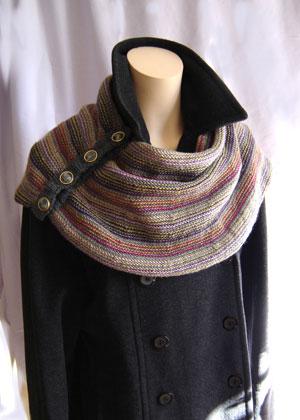
Beautiful Cowl


Flowery Scarf

Other Easy &Lovely Things from the Web

40 Edible Gifts


Ruched Headband

Peppermint Bark Soap


Felt Ornaments


a nice gift to make with children
Tutorial HERE


Tuesday, December 7, 2010

Favorite Sources for Patterns

After having had two drawers' worth of standard commercial patterns at one time - now considerably pared down - new ones are not often investments that I make. Working from home means I don't have to continually update a corporate "uniform," so in general most of my patterns come from vendors at sewing exhibitions or at specialty sites, and are geared more toward clothing that can double as art, or vice versa. Here are a few of my faves!

Of the patterns available commercially, my long-time favorite has to be the New Look line. Originally from Britain but acquired along the way by Simplicity, their patterns are versatile and affordable, offering many variations from the same pieces. Back in the late 80s, one of their suit-patterns was my go-to choice for my trade show wardrobe: toss in a couple of skirts and silk tanks, and I could pack pretty light for a trip that would take me from setup to working the booth to the reception circuit to teardown.


If you had to choose another general pattern line, I'd give Butterick a good look. They are to Vogue as Target is to Macy's, and the designs share some commonalities.

It's in the specialty area that the pattern possibilities start to get really fun, though, and the grandma of them all is Folkwear. They're a source that every costumer knows for authentic details - I know I have several versions of the Kinsale Cloak in my costume closet, in everything from woolen to velvet, not to mention cannibalizing the Austrian Dirndl for the basics of an Elizabethan bodice - but it's also fun to play with their pioneer and recent-history silhouettes. This pattern, for one, I'm dying to make. Keep your eyes open on eBay for discontinued designs.


Two of my other favorites I first discovered at a terrific sewing show that took place every year in San Mateo when I lived in the Bay Area. Park Bench Patterns, based in San Diego, includes some really interesting jacket/coat designs that lend themselves well to mixing/matching fabrics and wearable art. I especially like the draping and flow of their designs.


And at the annual Sewing and Crafts Show here in Victoria (which I hope is still happening - the host site returns 404 errors right now on anything not cached!), I still encounter the latest from The Sewing Workshop. Like Park Bench, their silhouettes are often asymmetrical, but their range is on the whole much broader and includes many more top and bottom options. My last project there was the Haiku Two jacket shown below, in a beautiful slubbed silk with an overall stippled black/gray/white pattern, but strewn with little jewel-toned bits.


The other nice thing about these more "artisan" patterns is that they are generally multiply-sized for the full small to extra-large range, so you can cut out the pattern on the largest size line you expect to need, and scale as needed from there for gift-giving.

Looking for something a little different to try? Check out one or more of these pattern sources. They're guaranteed to spark your creativity as well as ensure that you won't meet your own outfit coming and going!

Thursday, December 2, 2010

*Knock it Off!* JCrew Flats

by Kimberlee

Point of Confession - I love clothing & home goods catalogs.  Love love love them.  I'm not a big home shopper, but I am a big fan of styling, and prefer to see objects and clothing in context rather than how they are presented on websites: usually in stark contrast to a white background.

And to make matters worse, I'm not a big fan of stores- well, that's not exactly true, I'm not a big fan of malls.  Living in Minnesota makes being not fond of malls hilarious, as "The Mall" is right up the road.  My wonderful husband has to drag me out of Target ("Look at how shiny it is!") and threatens suicide inside JoAnn's, but generally I spend the vast majority of my browsing time on line.


Back to context.  I love how catalogs sell the dream of the object - beautiful objects in lovely rooms, impossible outfits, etc.


So when I came across these gold ballet flats in a J Crew catalog, I fell in love!  (Here is another image in silver)  I wanted them.  I needed them.  They're $198 dollars. Jaw/keyboard.

It was then that I heard The Voice.  The Voice has influenced all my immediate family members over the years, leading to projects both foolish and awesome.  The Voice that says, "Sure, "supple leather" sounds awesome enough, but wouldn't these flats,  purchased from Target (12 dollars!) last year for our wedding, work well enough?  The Voice that says, "HEY!  Those are button holes on the side of those "cluster of jewels." The Voice that says, "It's dumb to buy those, I can make it myself!"

So I already had the shoes, and it was just a matter of finding the other materials.
Here's the stash!

Things I ended up using:
- no sew iron-on tape
- ribbon (I used acetate BUT if I had to do it again I'd use silk or something like silk)
- gold & black thread
- wide black lace
- scrap pieces of black fleece or black felt
- black rosettes
- a variety of sizes of sew-on jewels
- various types of chain
- velcro
- iron
- sewing machine
I liked this ribbon, but maybe you should use something more luxe

You could also use pre-pleated ribbon.  I found some gorgeous pre-pleated ribbon at the store, but none were in black.  I considered doing the embellishment is another color, but though black would be more forgiving. 

Jewels, rosettes and chains
Using the curve of the shoes you plan to use, make a template for your embellishment.

Using some craft paper, I made a template that looks like a Pringles!
If you have pre-pleated ribbon, you can skip ahead.  For how to pleat, here we go....

I've never pleated before, so I just figured it out as I went. Using my black lace as a base,  I laid out strips of iron on sew tape.  I cut what I figured would be a long enough piece of ribbon and ironed on the end.  Then I made a pleat with the ribbon, ironing the edge of the pleat slightly further on the ribbon.  You can use a straight edge if you need to.  I'm having trouble explaining it, so let me show you the photos:
Iron on sew tape laid out on the lace

Fold ribbon over previous pleat
eyeball how far you want your pleat to go, slightly past the last pleat

Iron, rinse and repeat to end

OUCHIE!  My first iron-related mishap!
Make a long enough piece to have space to use 2 templates.  After you have a long enough piece and have applied the First Aid, use both sides of your template to trace out 2 pleated pieces.  DO NOT CUT OUT AT THIS POINT.

Put the lace backing on the fleece and sew along the traced lines, using your gold thread.  NOW you can cut, leaving about 1/4 inch raw on the outside of your stitching.


Two pleated patches with jewels and chains laid out

Figure out the arrangement of your rosettes, jewels and chains.  You should sew the chain on first.  Measure how much you will need to run the chain slightly inside the gold stitch, and double that amount, then cut your length of chain.  Double over your chain and hand-stitch on both chains at a time:
The black threads pretty much disappear
Hand-sew on the jewels first, then stitch your chain pieces around the jewels.  Then cut out the centers of the rosettes, sew them in place, then sew the jewels in the center of the rosettes.  Shape up your edges and you are practically finished!

Ready to put on your shoes!

Sticky-backed velcro


I suggest that you test the velcro adhesive on a small part of your shoe.   I could just glue them on my shoes, but I may want to remove them, make some other shoe accessory, retry making them, or put them on other shoes or even a headband.

But for now, the FINISHED RESULT! Or, Glamor Shots with Shoes


SHINY!

This was fun to do, and my first Knock-off.  Also, this was my first embellishment of a shoe since my Chuck Taylors in high school.  Which reminds me, I want to buy these and embellish my current pair of Chuckies.

Happy Hanukkah!


Wednesday, December 1, 2010

Chinese Leftovers - Tutorial Part 3

It was clear that the structure of the box would derive from the two "wings" that fold in being able to connect to the body of the box in a stable way.


Buttonholes and a button seemed like an obvious choice. But in order to make it reversible, I couldn't do a single buttonhole on each side, through both layers of each folded "wing" - that would only allow the box to assemble in one direction. Eureka! Make a pair of buttonholes in each wing, lined up to fall on top of each other perfectly so that the box could be buttoned up through all the layers!

I started out by marking the buttonhole positions based on the pinned-together box...but only on ONE side of each wing.


I then stitched and cut open those buttonholes, folded each wing into its finished position, and pinned through the finished buttonhole into the layer below, giving me a precise position that would line up with the first buttonhole. (Apologies for the blurry shot!)


With all the buttonholes completed and cut, the wings can be folded back into place, and a pin through all the openings will give you your final button position.


Making it reversible means you will have to sew two buttons at this position - one on either side of the fabric. I recommend using a button with a long shank - they are easier to work with back-to-back than a flat disc button, and the long shank is also friendlier when it comes to buttoning through four layers of fabric. I happened to have four old wood buttons with the look of bamboo - perfect for the theme!


So, we know it works...but, is it reversible?


Worked like a charm! Though a quick pressing is probably advisable before reversing, just for tidiness.

A traditional frog closure will be a perfect finish for the red-and-black side.


I'm not sure yet how I'll finish off the blue floral side. Maybe a fancy button with a thread chain closure in some silk buttonhole twist. And, for a strap? Simple - make one out of each fabric (+ interfacing for stability) in the desired length, just as you would a tie belt or a dress strap, topstitch the edges, add a buttonhole on each end, and button the strap right to the box! Alternatively, you could use a length of jewelry chain - something about the weight you'd use for a charm bracelet - add a lobster-claw clasp to each end, and clip it right to the button shank.

Now all you need are some fabric fortune cookies to fill it with, and you're good to go!